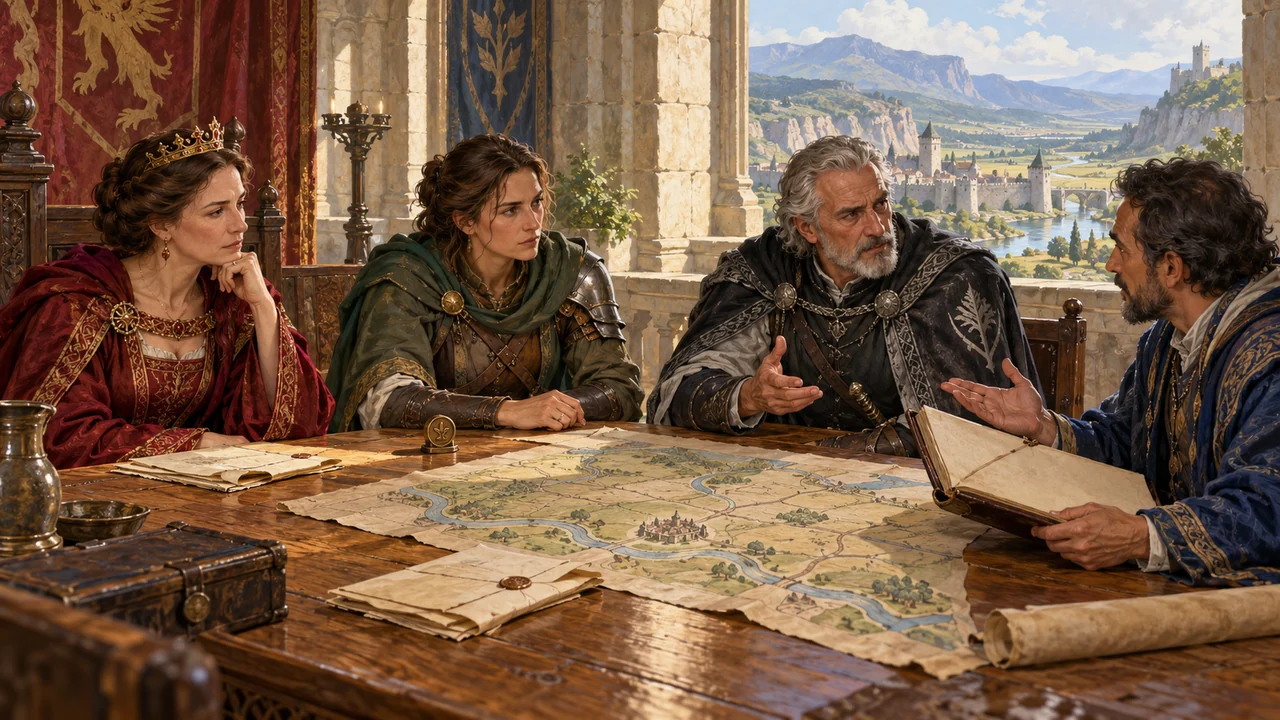
A queen replaces a border commander.
The appointment arrives, and the new commander takes the post. According to the original outline, she should now be ready to lead the troops out in the next scene.
But whom do the former commander’s officers report to? Who hands over the symbol of command? Will the merchants’ guild deliver the grain it promised under the same terms? And has the dismissed commander really lost every political position he held?
These questions tell you more about how a kingdom works than another list of noble titles.
To design a fantasy kingdom, start with why people recognize its rulers. Then work out who can appoint officials, levy taxes, move troops, settle disputes, and provide resources, and why others cooperate.
You don’t need every law and office in place first. Start with an order: who can issue it, who has to act on it, and who can set conditions? Politics will begin to affect your characters’ lives.
This guide uses the replacement of a border commander to explore royal power, nobles, and local interests. The first sections give you a kingdom-building method you can use on its own. At the end, we’ll follow the same handover in InkWeave to see how changes to organizations, items, and conditions can become visible and be checked as you write.
Contents
- Start with why people recognize the crown
- Separate appointments, taxation, military command, and judgment
- Give nobles and local powers reasons to cooperate or refuse
- Show politics in everyday life
- Test a transfer of power by replacing a border commander
- A kingdom power worksheet for your story
- Fantasy kingdom and political worldbuilding FAQ
- See the handover and validate its effects with InkWeave
Start with why people recognize the crown
“This country is ruled by a royal family” doesn’t yet explain why anyone accepts that family as its rulers.
Choose a few reasons your story needs.
Some people believe in bloodlines. Others recognize an election process, obey someone who offers protection, or simply lack the means to resist for now. Different groups in the same kingdom needn’t support a ruler for the same reason.
| Basis for rule | What do you need to establish? | What conflict might follow? |
|---|---|---|
| Royal inheritance | Who is eligible to inherit, and who confirms the succession? | The lawful heir and the person people support may differ. |
| Election or collective recognition | Who may participate, and how is the result accepted? | Someone accepts the process but opposes the chosen ruler. |
| Religious or ritual authorization | Who interprets the rules, and who can confirm or challenge a claim? | Those responsible for the ritual disagree with the ruler. |
| Conquest and military protection | Who submits, and what security or benefits do they receive? | Wartime support may not survive into peacetime. |
| Several sources at once | Which decisions need recognition from more than one group? | A royal bloodline still needs local cooperation to put policy into practice. |
These are options for designing fictional institutions, not a historical classification every kingdom must fit.
Nor do you need a justification everyone sincerely believes.
A noble may dislike the queen but consider the rules of succession more important than the person on the throne. A merchant may care little about royal blood, provided the roads remain open and someone honors existing promises.
The fictional kingdom in this article works like this: the royal family inherits the throne, with regional nobles recognizing the new monarch through deliberations at court. The queen can appoint military officers, but securing additional local resources requires negotiation.
That is enough to establish a useful distinction: the right to appoint someone doesn’t give you immediate access to every local resource.
Separate appointments, taxation, military command, and judgment
Power in a kingdom can be concentrated or dispersed.
You don’t have to decide in advance that one arrangement suits fantasy better. Ask what your story needs people to be able to do, then establish the limits and handover process.
In particular, don’t let “the monarch has power” answer every question.
Appointing a commander, demanding extra military funds, settling a land dispute, and requisitioning grain may all require different people to cooperate, even when the queen orders each one.
| Power | Questions to ask first | This kingdom’s simplified arrangement |
|---|---|---|
| Appointments | Who chooses someone, and who puts the appointment into effect? | The queen appoints commanders; the marshal arranges the army’s internal handovers. |
| Taxation and funding | Who collects and holds the money? How are additional demands handled? | The court has its own income; regions have established obligations. Extra military needs require negotiation. |
| Military command | Who issues orders, who relays them, and who leads the troops? | The marshal heads the army, with border commanders and captains carrying out orders at different levels. |
| Judgment | Who handles which disputes, and can a decision be challenged? | Some disputes are handled locally; questions involving the court’s commitments can be raised for further discussion. |
| Supply | Who arranges grain, transport, and equipment? | The River Valley Merchants’ Guild coordinates some grain shipments; keepers and storehouses release the actual goods. |
This table doesn’t need to list every official.
It helps distinguish several situations. Someone may have the right to decide but need others to act. Someone may keep supplies without having permission to give them away. Someone may be able to object without being able to secure the result they want.
Even concentrated power needs a process.
Your queen may have the final say, but messages still have to arrive and people still have to take over. You don’t need a scene for every dispatch. When the plot depends on that process, however, you can’t assume everyone knows at once and every handover happens simultaneously.
Once readers understand whom an order passes through, a political scene becomes more than someone announcing a result from a throne.
Give nobles and local powers reasons to cooperate or refuse
Nobles needn’t be collections of titles. A merchants’ guild needn’t be reduced to a guildmaster who funds the protagonist.
Give each important group three things: something it needs, something it can offer, and something it fears losing.
| Person or group | Reasons to cooperate | Conditions or concerns they might raise |
|---|---|---|
| The queen and court | Defend the border and preserve the credibility of royal orders. | They don’t want the border army becoming an unchecked local power. |
| Regional nobles | Keep roads safe and have their lands and existing agreements respected. | They don’t want to contribute extra funds without a say. |
| Border troops | Obtain supplies, pay, and orders they can carry out. | A new commander may not understand local conditions or may withdraw troops from people who need protection. |
| The River Valley Merchants’ Guild | Keep transport safe and recover money owed. | It wants old debts addressed before accepting the risks of a new supply commitment. |
| Local residents | Live, travel, and work without disruption. | They don’t want their needs always coming last in disputes at court. |
Different interests don’t necessarily make people enemies.
A guild asking for payment may need to cover its own transport and purchases. A captain reluctant to leave a post may be waiting for a replacement force, not preparing a rebellion.
Cooperation doesn’t mean permanent agreement, either.
A regional noble can support the queen’s succession while opposing this military funding arrangement. An officer can accept the new commander and still ask her to honor patrol commitments made to residents.
Believable politics doesn’t need a betrayal at every turn. People sincerely carrying out different responsibilities can come into conflict.
Characters can also belong to more than one organization.
Daren commands the border troops and is a regional noble with a seat on the royal council. Removing him from military service doesn’t necessarily cost him that seat. Mera reports to him and was once his student; a change in command doesn’t instantly erase their personal bond.
Keeping those positions separate gives characters more than one reason to act. Every shift in power needn’t turn a person from an ally into an enemy in every part of their life.
Show politics in everyday life
If your institutions exist only in the council chamber, the kingdom may look complete in your notes without being felt in the story.
Start with someone’s immediate difficulty and let the institution become part of it.
| What is happening now? | Which political arrangement does it involve? | How could it become a scene? |
|---|---|---|
| A grain-store keeper refuses to release goods. | Who takes over an old commitment, and who is responsible for payment? | The new commander discovers that the keeper is waiting for an accountable person’s answer, rather than simply defying her. |
| Villagers ask the troops to stay. | How are military movements balanced against local protection? | A captain asks who will take over road patrols, rather than merely declaring loyalty. |
| A merchant pursues an outstanding payment. | Does an organizational handover include unfinished business? | The former official has left, but the documents they signed still affect the next delivery. |
| A regional representative demands a place at a meeting. | Who has the right to be heard? | Someone without a military post can still challenge military spending. |
Readers don’t need to study the tax code first.
An argument over a delivery can show that a royal order and a commercial promise aren’t the same thing. A soldier waiting for a new superior to confirm a relief force can show how a change of personnel affects ordinary duties.
You can keep plenty of background off the page and write only what people need now.
If an institution changes no choices and won’t appear again, a brief note may be enough. Give it more attention when it starts determining whether characters can act or whom they must ask for help.
Writing note: Institutions should create situations, not homework
You don’t need a tax schedule for every noble’s estate or full minutes for every meeting. Start with the people, resources, promises, and authority that affect this part of the story. Add the rest when you need it.
Test a transfer of power by replacing a border commander
The queen thinks the border army has become too dependent on Daren’s private arrangements with the local guild. She appoints Vera to replace him.
Daren believes he kept a supply route working when the court failed to provide what the troops needed on time.
You don’t have to declare either of them entirely right. First, give each position reasons a reader can understand.
In this version, Daren doesn’t merely receive a new title. He is relieved of military duty and leaves the Royal Army, while retaining his regional seat on the royal council. The marshal is the army’s overall leader. Mera and Toren originally report directly to Daren.
The handover involves several actual changes.
| Stage | What has happened? | What can’t you assume along with it? |
|---|---|---|
| The court announces the appointment. | The queen names Vera to take charge of military affairs in the north. | Everyone locally has received the news and completed the handover. |
| Daren leaves the army. | Daren loses his military post and membership in this organization. | He also loses his council seat, family ties, and every source of influence. |
| Existing officers are placed under temporary command. | Mera and Toren report to the marshal for now. | They have automatically become Vera’s direct subordinates. |
| Vera takes command. | Vera joins the relevant military structure, and the two captains are reassigned to her. | They trust her completely or no longer care about Daren. |
| The seal changes hands. | Daren gives Vera the border command seal he holds. | Every authorization, contract, and supply transfers with the object. |
| Grain supply is renegotiated. | The court, new commander, and guild agree who handles old debts and future supply. | The grain has already arrived, or quantities in the storehouse no longer need a source. |
These don’t have to be six separate scenes. You can combine some and let others happen offstage.
But if a later scene uses a result, you need to know whether it actually happened.
Vera might arrive with her appointment but still need the marshal to arrange the handover. She might receive the seal first, then discover that the supply agreement runs only until the end of the month and must be renegotiated.
Daren can leave the army and continue opposing her resource arrangements at court. That isn’t the writer forgetting his dismissal. His military post and council seat were separate positions to begin with.
The story can move forward without an endless supply of new betrayals.
An appointment settles one matter while making other people reconsider their responsibilities, relationships, and promises.
A kingdom power worksheet for your story
Fill out a short table for your kingdom first. You don’t need to finish every institution at once.
| Setting detail | Example from this kingdom | Questions for your story |
|---|---|---|
| Why the crown is recognized | Royal inheritance, with regional nobles recognizing the succession at court. | Who considers the claim valid, and who merely accepts it for now? |
| Who appoints people | The queen appoints commanders; the marshal handles the army’s handovers. | Who is involved between the announcement and the person taking office? |
| Who controls the military hierarchy | Marshal, commander, and captains exercise command at different levels. | When someone leaves, what happens to the people who reported to them? |
| Who provides resources | The court, regions, and guild each provide different parts. | What can no longer happen as planned if someone refuses, delays, or renegotiates? |
| Who handles disputes | Some matters are handled locally; the court discusses questions involving shared commitments. | Where can a character turn if they consider something unfair? |
| One person’s different positions | Daren leaves the army but retains his council seat. | Which position does this particular change affect? |
| Visible symbols of power | The border command seal has a known holder and a handover date. | What does the object represent, and what powers can’t it grant on its own? |
| Unfinished obligations | Old supply debts and a new agreement still need someone to handle them. | When the people change, who takes responsibility for unfinished business? |
After planning a political change, ask:
- Does it change a title, a reporting line, organizational membership, or some other authorization?
- Who is directly affected, and who has merely heard the news?
- Have the relevant items, resources, and obligations actually been handed over?
- Can characters accept the new arrangement while retaining old relationships and opinions?
- Does a later scene rely on an appointment, agreement, or qualification that hasn’t been established?
Once you have enough answers to support the next part of the story, write it.
Political worldbuilding shouldn’t keep you in preparation forever. It should help you understand what new problems a person’s decision creates for everyone else.
Fantasy kingdom and political worldbuilding FAQ
Do I have to model the kingdom on a real dynasty?
No. You can begin with institutional questions you understand or invent your own rules. Just don’t assume that borrowing a few noble titles recreates the institutions they came from.
If your work draws explicitly on a particular period, research still matters. This simplified example isn’t a substitute for historical research. A wholly invented kingdom also needs its important rights, responsibilities, and changes to fit together.
Do local powers matter if the queen is very powerful?
How much they matter depends on your story.
Local people needn’t have a legal veto. They might control roads, transport, skilled workers, or a resource that can’t be replaced quickly. You can concentrate royal power while retaining the practical processes needed for execution, communication, and supply.
How do I keep political worldbuilding from becoming an instruction manual?
Choose something a character is trying to obtain, refuse, or hand over, and let the institution emerge through the problem.
Vera discovering at a grain store that her appointment cannot replace delivery arrangements makes the limit easier to understand than an introduction to ten offices. When a character needs a rule, let dialogue, action, and consequences explain it.
See the handover and validate its effects with InkWeave
You can use the tables above to develop your kingdom, then start writing.
If you want important appointments, reporting lines, and handovers to appear at the point you are writing, rather than remain in notes, you can follow this same handover in InkWeave. It can also check what happens when revisions change the earlier events.
A character can hold positions in more than one organization
The Royal Court, Royal Army, and River Valley Merchants’ Guild can each be created as a faction. Here, a faction means an organization with members, titles, and internal relationships. The groups needn’t be enemies.
At the relevant starting point in your story, establish their leaders, members, and reporting lines. Then record later changes where they happen in the manuscript.
Daren is the northern commander in the army and a councillor representing the local nobility at court. Recording his departure from the army doesn’t also remove his position at court.
Changing an organizational title, changing a reporting line, leaving an organization, and changing a character’s ancestry or class are different events. Moving someone from one military post to another needn’t mean replacing their entire character class and its attributes just to update a job title.
Choose the change that matches what happens in your story.
Mera and Daren’s bond as former student and teacher can also be recorded separately as a character relationship. A change in military command doesn’t decide for you whether their personal relationship ends.
Decide how a departure affects subordinates
When Daren leaves the army, you decide what happens to his officers.
InkWeave offers different options, and the Causality Engine derives their effects from the organization’s structure at that point.
| Arrangement you choose | What changes in the organization? | When might it fit the story? |
|---|---|---|
| Subordinates leave with the departing character. | Every member below the departing character in the hierarchy leaves too. | You decide that the former commander and the whole branch under him leave together. |
| Subordinates stay without a superior for now. | Direct subordinates remain members, but their previous reporting lines are removed. | The handover is incomplete and new reporting lines must be arranged later. |
| Direct subordinates move up to the departing character’s superior. | They report to the person their former superior reported to. | A higher authority takes temporary responsibility before the new commander takes over. |
This example uses the third option.
Daren reported to the marshal; Mera and Toren reported to Daren. Once you confirm his departure and choose to move his direct subordinates up, the two captains report to the marshal under that rule. You don’t have to repeat the same upward reassignment for each person.
That doesn’t automatically place them under Vera. The new command structure becomes part of the history when you confirm her entry into it and the captains’ reassignment to her.
The engine isn’t guessing who is more loyal. You choose the arrangement, and the recorded organizational relationships determine whom it affects.
| Where is the cursor? | What can you see? |
|---|---|
| Before Daren leaves | Daren still belongs to the army, and Mera and Toren report directly to him. |
| After his departure and the upward reassignment | Daren is no longer an army member, and the captains report to the marshal. |
| After Vera takes over | The new reporting lines are established. You can still return to an earlier passage to see the old arrangement. |
| When viewing the court | Daren’s council seat in the other organization remains. |
The organization chart at that point shows which connections have changed. A character’s membership history also lets you trace the resulting changes back to the departure that caused them.
You haven’t written a separate setting update for every affected person, yet their positions have changed together as a result of the same decision.
Connect the seal, supplies, and authorization to the same history
A handover doesn’t happen only on an organization chart.
The seal Daren holds can pass to Vera through an item-transfer event. If grain matters enough to track, keep it in a location’s inventory and record who receives it from the storehouse. A guild agreeing to supply grain doesn’t make the goods arrive by themselves.
The scene-aware view and Inspector beside your writing bring recorded characters, items, locations, and factions into view as they were at the cursor’s point in the story. Add images, and those people and objects can have visible identities too.
When a character and the seal form a supported interaction, the event wizard can show who holds it and let you confirm whether a transfer occurs. Talking about the seal doesn’t have to change its holder.
After writing the handover, look at Vera later in the story and you can see that she has received it. Return to the earlier meeting, and Daren still holds it.
That feedback can make a political handover feel like part of an adventure. You write people’s decisions, then see officers, symbols of command, and supplies move as those decisions take effect. Instead of facing a list of official records waiting to be updated, you can follow people experiencing changes in the same world.
If a future deployment really does depend on authorization and an agreement, you can define flags and add a condition check.
| What does the future scene require? | What do you establish earlier? | What does the Causality Engine check? |
|---|---|---|
| This deployment has been authorized. | Set a flag such as “Deployment authorized” where the authorization actually takes effect. | Whether the flag has been set to the required value by the point that needs it. |
| The guild accepts the new supply arrangement. | Set the relevant flag when the agreement is reached, and record a change if it is later withdrawn. | Whether the state at that point still meets the later scene’s requirements. |
You can place the condition check in a future passage to keep missing prerequisites visible. As you write the negotiation, confirm the result, and record the corresponding events, validate those conditions again.
How it works: The seal, title, and authorization have separate records
Receiving the seal doesn’t automatically set a deployment flag. Changing a title to commander doesn’t establish every permission. You define and update flag conditions explicitly; arbitrary item quantities or organization-chart queries aren’t automatically treated as political qualifications the engine understands.
You don’t need conditions for every meeting. Record the outcomes that later scenes genuinely depend on and that you want to keep checking.
The engine flags broken hierarchies and changed consequences
InkWeave doesn’t leave you to inspect every change yourself.
After saving, the Causality Engine automatically validates the whole project. If organizational hierarchies, departure effects, or defined conditions have problems, the relevant events in the manuscript and the project-wide dashboard show what needs attention.
| What arrangement appears? | What can the engine flag? |
|---|---|
| Mera still reports to the marshal, but the marshal is also assigned as her subordinate. | The reporting lines form a cycle, so the hierarchy doesn’t work. |
| You keep subordinates without a superior and haven’t arranged new reporting lines. | Which departure left members without a superior. |
| The faction’s overall leader leaves while other members remain. | The leadership vacancy, rather than automatically choosing a successor. |
| A later scene requires deployment authorization, but the relevant flag doesn’t meet that requirement. | The explicitly recorded prerequisite that is still missing at this point. |
A warning doesn’t mean you aren’t allowed to write a vacancy or a period of confusion.
That transition may be precisely the story you want. The engine makes the state and its effects visible. Whether you arrange a replacement, a split, a negotiation, or leave the problem unresolved is still your decision.
For example, you confirm Daren’s departure and accept its effects: Mera and Toren both move up to report to his superior. Later, you revise an earlier chapter so Toren has already been reassigned elsewhere.
On revalidation, Daren’s departure no longer affects the same two people. The engine compares the current result with the result you previously confirmed and flags that the departure’s knock-on effects have changed.
It doesn’t just count people. The same number of officers reporting to a different superior can also differ from the arrangement you accepted.
| What changes in revision? | Why does it need another look? |
|---|---|
| Toren is reassigned before Daren leaves. | He should no longer be treated as moving up with this departure. |
| Daren’s own superior changes earlier. | His officers may now report to someone other than the person in the original arrangement. |
| Daren has already left the army at an earlier point. | A repeated departure later may no longer have its original effect. |
Go to the relevant event to inspect the current effects, revise the arrangement, or accept the new consequences. Departure effects that you have confirmed and that haven’t changed don’t need repeated confirmation. A change to the earlier events gives you a reason to revisit them.
These effects and checks come from InkWeave’s in-house Causality Engine. It uses confirmed events and rules for deterministic calculation, not AI reading political scenes, guessing loyalty, or deciding who should obey.
It doesn’t choose your kingdom’s institutions or predict who will rebel. You decide what the characters do. The engine turns those choices into visible organizational and item histories, and flags later events or revisions that no longer fit what came before.
Getting started: Begin with one handover
You don’t need every official in the kingdom first. Start with a commander, their superior, two captains, and a seal. Add other people and organizations as the story needs them. Not everything you can track needs tracking, but one important record can give you an organization chart, state at a particular point, a history to revisit, and checks on later events.
To create a few characters and an organization, then record a handover, follow the Getting Started guide. For downloads and available plans, see InkWeave Pricing.
A believable kingdom doesn’t need everyone to obey, or every opponent to be an enemy.
The queen makes the appointment. Vera receives the seal. Mera asks who will take over the patrols. The guild representative brings the old debt back to the table.
Everyone is responding to the same event, with different responsibilities and needs.
When those responses change later personnel, resources, and choices, the kingdom becomes more than a map with borders.
It becomes a world your characters have to live in, but can also negotiate with and change.