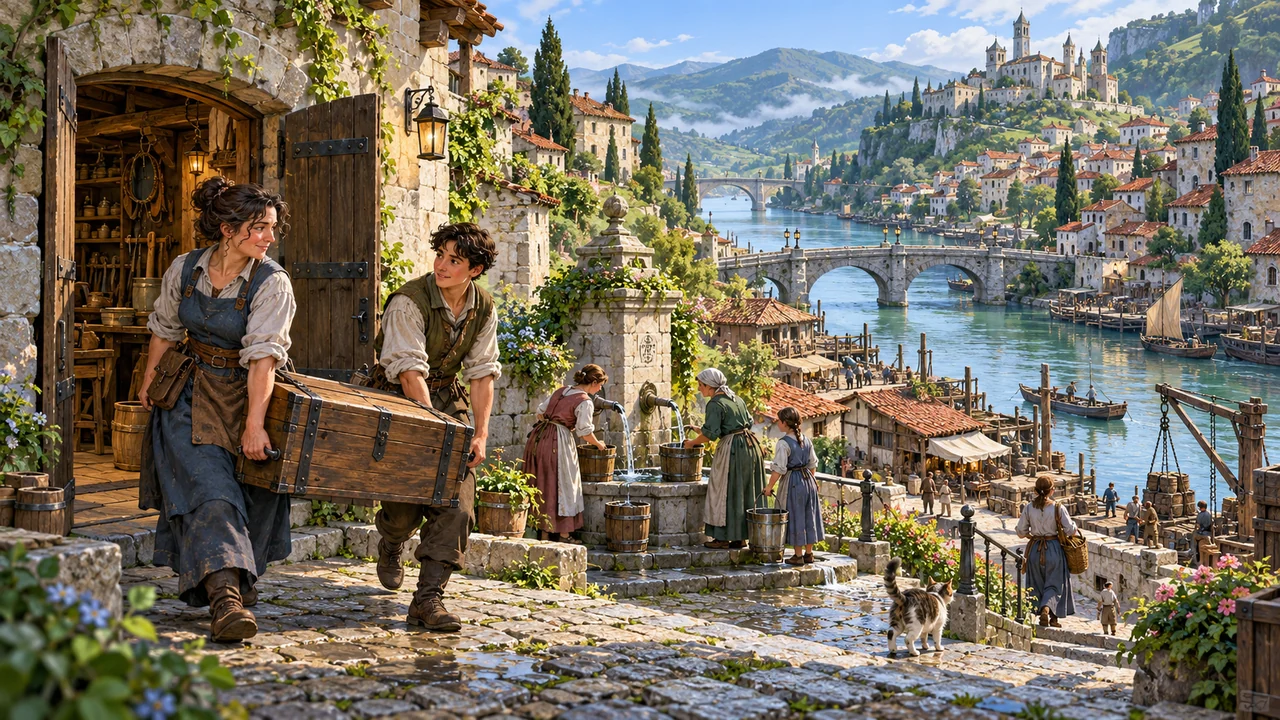
You may already have drawn your fantasy city’s walls, palace, market, and streets, yet still struggle to bring it into the story when a character arrives.
Adding another temple doesn’t seem to make it feel more lived-in.
The problem may not be a shortage of buildings. Perhaps you haven’t yet decided why people live here, what they need each day, or which places and people they depend on.
To design a fantasy city, start with why it exists. Then connect a few important places through water, food, work, transport, and housing. You don’t have to finish the whole map or create every resident. Give your characters enough of a city to live through one day, and you have somewhere to begin.
This guide follows the fictional city of Twinbridge, from everyday routines to the aftermath of a riverside workshop’s collapse. You can use the example to develop your own city, then see how InkWeave makes its changes visible as you write and flags events that no longer fit what came before.
Contents
- Start with why the city exists
- Find essential places through a resident’s day
- Give districts different advantages and burdens
- Give locations a current state, people, and belongings
- Test the city’s connections with a workshop disaster
- A fantasy city worksheet to start writing with
- Fantasy city design FAQ
- See city changes and validate later events with InkWeave
Start with why the city exists
Write one sentence about the city before writing thousands of years of history.
That sentence should answer two questions: why people gathered here, and why they stayed.
Twinbridge begins like this:
“Two trade routes meet in a river valley, where two bridges carry people and goods between the banks. A nearby mountain spring supplies drinking water. Wharves, workshops, and markets have grown along the river.”
This isn’t a finished city, but it gives you reasons to put things where they are.
Merchants need places to unload and store goods. Craftspeople want access to materials and customers. Residents need somewhere they can reach to collect water. Those who guard the bridges control passage, while people living on lower ground watch the water level.
Different beginnings give a city different problems.
| Why the city exists | Why people stay | Everyday life and conflicts it might create |
|---|---|---|
| A river and trade routes meet here | Transport, trade, and employment | Bridge tolls, incoming cargo, storage, and risks along the river |
| A mine or unusual resource | Income from extraction, processing, and supply | Who gets access, and who bears the cost of the work |
| A mountain pass or military stronghold | A garrison needs people to supply it | Travel restrictions, military supplies, and different treatment of locals and outsiders |
| A center of pilgrimage or learning | People come for faith, knowledge, or qualifications | Lodging, services, admission requirements, and permanent residents’ needs |
| Magic or unusual terrain | Something found only here supports the settlement | Who maintains it, who can use it, and who suffers when it fails |
These are possible starting points for fiction, not historical formulas every city must follow.
A city’s present reason for surviving may differ from the reason it was founded. A mine can run dry. A fortress can lose its military purpose. A settlement that once gave travelers a place to stop at a bridge can become a trading center.
Those changes can leave useful traces: an old city wall incorporated into houses, an abandoned checkpoint turned into a market, or a street named for a trade that has disappeared.
You don’t need the entire history yet. Choose one piece of the past that still affects life today, and put it somewhere your characters will encounter it.
Find essential places through a resident’s day
It’s easy to keep adding buildings to a map without giving characters any reason to use them.
Try working in the other direction. Choose a few people, follow them through a day, and see which places the story needs.
Twinbridge has three workshop characters: Isa, a craftswoman; Rowan, who knows the old water channels; and Luke, an apprentice.
They aren’t the city’s entire population. They are a few perspectives through which you can begin to see it.
| Part of a character’s day | What do they need? | Which places does that suggest? |
|---|---|---|
| Isa goes out to repair the public fountain in the morning | Food, tools, and a way to reach the job | Her home, a breakfast stall, the riverside workshop, and the upper-town fountain |
| Luke carries materials for the workshop | Somewhere to buy them and a route he can move them along | The market, unloading areas, bridges, and steps or cart ramps |
| Rowan handles more complicated repairs | His illustrated repair manual, parts, and people to work with | The workshop, somewhere to keep reference material, and other craftspeople’s workplaces |
| Nearby residents wait to collect water | Usable water, plus time to queue and carry it home | The fountain, paths to their homes, and possible alternative water sources |
Then ask a few questions that are easy to overlook.
Where does food enter the city, and where is it stored? Where do people live after work? Who handles wastewater and rubbish? Can people travel at night? Where do they turn when someone is sick or injured?
You don’t need a complete institution for every answer. Work out the part your story uses first.
For example, Luke can walk up the short flight of steps beside the fountain empty-handed. He can’t push a cart full of tools up the same steps. Characters heading to the same destination may need different routes because of what they are carrying.
You can write that without a street plan drawn to scale.
A rough sketch marking the river, bridges, slopes, and a few important places is often enough to start arranging movement. Add the relevant distances and passages when the story needs a chase, a heavy delivery, or a siege.
A city’s sense of space comes not just from the roads you draw, but from why different people use them.
Give districts different advantages and burdens
“The rich live in the upper town, and the poor live below” can be a starting point. It doesn’t yet make either neighborhood feel inhabited.
You also need to know what people gain by living there, and what they put up with.
Twinbridge’s riverbank makes unloading goods and obtaining materials convenient, so workshops are reluctant to leave. When the river rises, however, the lower buildings face the risk first. The upper town has storehouses farther from the water, but hauling goods uphill takes effort, and not everyone can afford the rent.
A place can offer advantages and impose burdens at the same time.
| District or place | Why do people need it? | What might they have to deal with? | Where could a story begin? |
|---|---|---|---|
| Riverside workshop street | Access to cargo, materials, and equipment needing repair | Changing water levels, damp, and the difficulty of relocating | Whether craftspeople will stop work early to move their tools |
| The bridgehead market | Passing trade and opportunities to hear news | Crowds, tolls, and competition over stall space | Who hears first, and who is stranded on the other bank |
| The area around the upper-town fountain | Convenient water access and nearby services | Queues, interrupted repairs, and competing needs for water | Residents and craftspeople disagreeing over what to fix first |
| The upper-town storehouses | Somewhere to keep goods away from river water | Rent, hauling goods uphill, and competition for space | Which belongings deserve to be moved first |
Don’t give everyone in a district the same opinion.
Dockworkers may need riverside jobs, while a shopkeeper wants fewer loads carried past the door. People living near the fountain may feel they have waited long enough. Someone collecting water for distant neighbors may think the city shouldn’t favor the nearest street.
Disagreement can grow from circumstances. It doesn’t always need to be a conflict between good people and bad ones.
This is also a useful place to introduce fantasy elements.
Suppose Twinbridge’s bridge lamps rely on light-storing stones that need regular replacement. Who replaces them? Where do the stones come from? Who needs to cross at night? Who suffers most when the lamps go out?
Not every building needs an enchantment. One unusual feature can distinguish a city if it genuinely changes how people live, work, or exercise power.
Give locations a current state, people, and belongings
“Riverside workshop: repairs equipment for the public fountains” is a useful setting note.
Once the story starts, you will need more than that.
Can anyone enter it now? Is it still operating? Who is inside? Is the toolbox stored there, or has the apprentice taken it away? Is the repair manual on a shelf, or is Rowan carrying it?
These aren’t decorative details. When a character needs tools, a colleague, or somewhere to work, the answers shape the next scene.
| Aspect of the location | What might you establish initially? | What needs checking after an event? |
|---|---|---|
| Purpose | The workshop repairs the public fountains | Where does the work move if the workshop becomes unusable? |
| Access | Craftspeople and visitors can normally come and go | Is entry restricted, is leaving restricted, or has the place been destroyed? |
| People present | Who is working there that day | Who has left, who remains, and what happened to each person? |
| Items stored there | A toolbox and spare parts are kept in the workshop | Which have been moved, and which remain? |
| Items carried by characters | Rowan has the repair manual | Has he handed it over, or does he still hold it? |
Some of these facts need to stay separate.
A person standing inside a workshop doesn’t make everything they carry part of the workshop’s inventory. A workshop collapsing doesn’t mean everyone inside dies.
Likewise, a missing character isn’t confirmed dead. Their belongings might disappear with them, have been handed over earlier, or turn up somewhere else. Each possibility leads to a different story, and you decide what happens.
Keep track of the distinctions that will matter again.
Every hook on the wall may not be important. If the toolbox determines whether Isa can keep repairing the fountain, it deserves a clear history of where it goes.
Writing note: You don’t have to track everything you could track
A city needs to feel lived-in; it doesn’t need a register of every household. Record changes that affect character choices, later scenes, and important items. The rest of the streetscape can stay in the prose.
Test the city’s connections with a workshop disaster
You don’t have to destroy a city to find out whether it feels alive.
A workshop closing, a bridge becoming temporarily impassable, or a skilled craftsperson going missing can reveal the connections between places.
This example uses a rising river. It is a fictional event chosen for this story, not something every fantasy city needs to experience.
| Point in the story | What actually happens | What changes for the city? |
|---|---|---|
| Ordinary life | Isa, Luke, and Rowan are in the riverside workshop. The toolbox is stored there; Rowan has the manual. | The workshop provides space, tools, and repair expertise. |
| The river rises | The workshop closes to incoming visitors, while people inside can still leave. | People elsewhere can no longer treat it as an ordinary open destination. |
| Tools are moved | Luke takes the toolbox to the upper-town storehouse and leaves it there. | The tools still exist, but they are no longer at the workshop. |
| The workshop collapses | Isa and Rowan are still inside. Isa survives; Rowan goes missing. | The building’s destruction and each person’s fate are separate. Luke is not present at this moment. |
| Work is rearranged | After her rescue, Isa goes to the storehouse and starts handling repairs she knows how to do. | Having tools doesn’t restore all the information and experience Rowan provided. |
| Rowan returns | Rowan reaches the storehouse alive and hands the manual to Isa. | His return, his change of location, and the handover each happen at a particular point. |
The disruption can bring out human concerns, rather than simply add a disaster sequence.
Isa wants to repair the public fountain, but the storehouse keeper needs to keep space clear for deliveries. Luke’s rescued tools prove useful, though some jobs may have to wait for Rowan or another willing craftsperson.
You can let residents help one another, or let old grievances surface. The scale of the disruption is yours to choose. One damaged workshop needn’t leave the whole city without water. Perhaps one district temporarily uses a different fountain.
Work it out for yourself first. Then choose how much the reader needs to see.
Readers needn’t follow every stage of the tool delivery. They can see its result when Luke opens the storehouse and finds the tools he saved. Isa’s difficulty without the manual can emerge through her work and conversations, rather than an explanation of municipal facilities.
A believable city doesn’t require every background fact on the page. It requires the next action to take account of what has already changed.
A fantasy city worksheet to start writing with
Fill in enough to support the story in front of you.
If you don’t know the population, you don’t need to invent a number yet. Knowing who needs water, how goods cross the river, and where a character’s home sits relative to their workplace is often more immediately useful for writing a scene.
| Setting detail | Twinbridge example | Questions for your city |
|---|---|---|
| Reason for existing | Trade routes meet in a river valley; two bridges carry people and goods. | What brings people together, and what keeps them here? |
| Water | Channels carry spring water to public fountains; craftspeople maintain parts of the supply. | Where does water come from, who uses it, and what alternatives exist if something fails? |
| Food and supplies | Goods enter by bridge and wharf, are traded in the market, and may be stored in storehouses. | How do arrival, storage, and use connect? |
| Work | Riverside workshops, hauling, trade, and equipment maintenance depend on one another. | Whom do residents work for, and what does that work require? |
| Housing differences | Riverside homes are near work; the upper town is farther away but offers space above the water. | What advantages and burdens come with a home here? |
| Transport | Bridges link the banks; ramps and steps suit different ways of moving goods. | Do pedestrians, carts, and night travelers use the city in the same way? |
| Day-to-day decisions | Different people arrange fountain repairs and storehouse space. | Who handles disputes, and who can agree or refuse? |
| Local character | Bridge lamps use light-storing stones that someone must maintain. | How does an unusual feature affect everyday life? |
| Places that have changed | The riverside workshop has collapsed; some work has moved to the upper-town storehouse. | Which earlier version of a place can no longer be used unchanged? |
After writing a city scene, check:
- Why does the character go here rather than somewhere else?
- Are the people, items, or services they need still available at this point?
- Does their journey respect the restrictions in effect then?
- How do nearby people adjust when a place changes?
- Do these details emerge through action, rather than simply add more explanation?
You can leave unused fields blank.
City design should help you write the next scene. It shouldn’t become an administrative report you must finish before you are allowed to begin.
Fantasy city design FAQ
Do I need a complete city map first?
No. You can start with relative positions, marking important water sources, barriers to travel, workplaces, and homes.
Add detail where an event needs precise locations. A character going from home to the workshop doesn’t require names for every alley. A chase or a heavy delivery gives you a reason to work out the relevant routes more clearly.
Do I need population figures and a complete supply model?
No. Start by keeping the everyday conditions your story repeatedly uses consistent.
Population and supplies matter more in a story about a siege, famine, or mass evacuation. Even then, you can establish a scale that supports the story without simulating every person’s meals.
How do I make the city feel distinct?
Choose a few features that have lasting effects on life, rather than merely renaming familiar buildings.
Unusual terrain, a unique resource, seasonal changes, religious practices, or magic can all work. Then ask how different residents depend on, maintain, use, or reject that feature. Their different responses help turn a setting detail into a story.
See city changes and validate later events with InkWeave
You can develop all the city details above in whatever notes you prefer.
When you want to see important changes at the point you’re writing, trace how they happened, and check later events against them, InkWeave can continue this same workshop story. It combines manuscript writing with tools for managing characters, places, and items, so you don’t have to keep a separate, ever-changing version of the city in sync by hand.
Start seeing the city through a few people and places
You don’t need to build all of Twinbridge first.
Start with the three characters, the riverside workshop, and the upper-town storehouse. Add the toolbox and manual because they matter to this sequence. The toolbox begins at the workshop; Rowan holds the manual. As you confirm pickups, movements, and placements, record those events where they happen.
Together, these small records give you feedback while you write.
| Where are you in the story? | What can you see or check? |
|---|---|
| While the workshop is still operating | The location’s state, the characters present, and the items stored there. |
| After Luke takes the toolbox | The tools are no longer stored at the workshop; Luke holds them. |
| After the toolbox is placed in the upper-town storehouse | The storehouse contains the item, and Luke no longer carries it. |
| After the disaster and the characters’ outcomes are confirmed | The workshop is destroyed. Isa is alive; Rowan is missing. Their outcomes remain separate. |
| After Rowan returns and hands over the manual | He has rejoined the others and reached the storehouse; the manual has a new holder. |
The scene-aware view and Inspector beside your writing show the recorded state of characters, places, and items at the cursor’s position in the story. Add images, and the workshop, storehouse, craftspeople, and tools can have visible identities too.
When characters, locations, and items form a supported interaction, the event wizard can show their current state and let you confirm whether a movement, pickup, or placement happens here. Mentioning the workshop doesn’t automatically send a character inside.
You can confirm an important event from the prompt, or simply continue writing. When you want to know who visited or how an item arrived, open the location’s visitor or item history.
You aren’t filling out another form after every sentence.
You have just written Luke moving the tools. When you reach the storehouse later, you can see what his action left there. Move the cursor back to an earlier passage, and the tools haven’t been moved yet. Writing can feel like following your characters on an adventure, with the city around them gradually acquiring the history you have written.
A destroyed workshop doesn’t give everyone the same fate
InkWeave supports location states for open access, restricted entry, restricted exit, sealing in both directions, and destruction.
These differences affect later validation. They aren’t just descriptions on a reference page.
| Location state | What it means for access | How it applies to the workshop story |
|---|---|---|
| Open | Characters can enter and leave. | Ordinary visits and work. |
| No Entry | Entry from outside is restricted; people inside may leave. | Visitors are kept out, but evacuation remains possible. |
| No Exit | Leaving is restricted; entry is allowed. | This isn’t the appropriate state for the evacuation in this example. |
| Sealed | Both entry and exit are restricted. | You can’t keep this state in effect and treat movement in either direction as unrestricted. |
| Ruin | The location is destroyed; later entry is flagged by validation. | The original workshop can’t simply carry on unchanged in later scenes. |
When you open the detailed outcome settings for a location’s destruction, InkWeave uses the characters’ positions at that point to identify those affected. You can set each person’s outcome to alive (Active), Missing, Dead, or Unknown, or apply a choice to the group.
Isa can therefore survive while Rowan goes missing. Luke, who has already left, isn’t on the list for that moment. Once you confirm the outcomes, the corresponding character-status events are added together; you don’t have to recreate the same changes one person at a time.
Alive doesn’t mean uninjured. If injuries matter, you can describe them in the prose or track them through suitable custom attributes. Missing doesn’t mean dead, and Rowan’s manual doesn’t automatically become an item left behind for someone else to collect.
If another story does call for a death, the detailed settings can also handle the dead character’s items, leaving them at the location or transferring them to an eligible character present there. Different choices leave different worlds behind.
Nor does marking a location as destroyed automatically delete everything stored there. Whether items were damaged, moved earlier, or left behind depends on the events you confirm. Items remaining at a location do not make a destroyed place freely accessible again.
The engine flags movement into an inaccessible location
You don’t have to remember to open a reference page before the city’s state can help you.
Suppose you forget the collapse later and create a movement event sending Luke into the riverside workshop. The Causality Engine checks the history at that point: the destination has been destroyed, so entering it conflicts with its current state.
Automatic validation after saving marks the movement event in the manuscript with the error and its reason. It also provides a way to jump back to the earlier location-state event. You don’t have to remember the disaster yourself before you know this passage has a problem.
| What happens later? | What does the Causality Engine distinguish? |
|---|---|
| The workshop has No Entry set, but a movement brings someone in from outside. | It identifies the entry restriction and lets you trace it back to the event that established it. |
| The workshop has No Entry set, and Luke leaves from inside. | It doesn’t mistake an entry restriction for a ban on leaving. |
| A character leaves a location with No Exit set. | It identifies the departure restriction at the starting location. |
| A character is sent into the workshop after its destruction. | It identifies the destroyed destination as the reason this entry doesn’t fit. |
The check has a specific cause. It doesn’t vaguely suggest that something “might seem wrong.” It tells you which event conflicts with which existing state.
You still decide what to write. Change the action, send the character somewhere else, or revise the earlier events. The engine doesn’t rewrite the plot for you, and a diagnostic doesn’t stop you from continuing to type.
How validation works: It checks the events you establish
These movement checks use the movement and location-state events you confirm. InkWeave doesn’t infer an entire situation from a sentence such as “He entered the workshop.” A memory, an imagined visit, or a passing mention needn’t become a real movement event.
Find affected scenes after revising earlier events
You might write the characters’ journeys first, then decide that the flood should arrive earlier.
When you adjust the corresponding events and their order, later actions that once worked may lose their prerequisites. InkWeave automatically validates the whole project after saving. Its project-wide dashboard lists chapters and issues that need attention, so you can go to the relevant passages.
| What changes in revision? | What might be flagged later? | How could you continue? |
|---|---|---|
| You bring forward the workshop’s No Entry restriction or destruction. | A later entry that was previously valid now conflicts with the location’s state. | Change the visit’s timing, choose another destination, or revise the location events. |
| You move Luke’s evacuation to after the collapse. | The characters affected at the moment of destruction no longer match the list you previously confirmed. | Reconsider what happens to him, or adjust the earlier evacuation. |
| You remove Luke’s pickup of the toolbox but keep his placement of it in the storehouse. | The later transfer may lack the available quantity and the earlier acquisition that supports it. | Establish a valid pickup, or change who moves the tools and where they go. |
For example, if Luke is now still at the workshop, the engine flags that the confirmed list of affected characters has changed. It doesn’t quietly decide that he, too, must die or go missing to fill the gap.
Revise the cause, confirm the new outcome, and let the engine check again. That gives you room to try different arrangements without keeping every later dependency in your head.
These state calculations and checks come from InkWeave’s in-house Causality Engine. It uses explicit events and rules for deterministic calculation, not AI reading the manuscript and guessing at contradictions.
The engine doesn’t draw the city’s road network, calculate flood behavior, invent a missing character’s escape, or simulate every resident’s life. It connects the changes you confirm, shows the people and items at that point, and flags later events that no longer fit those conditions.
Getting started: Let one place and a few important items change
Begin with the workshop, storehouse, three characters, and the tools this sequence needs. Other districts, everyday objects, and passersby can stay in the prose. Add them when they begin to matter. A handful of recorded actions can already give you visible state changes, a history to revisit, and checks on later events. You don’t have to finish setting up the whole city first.
To try taking a tool from a location, giving it to a character, and placing it somewhere else, follow the Getting Started guide. For downloads and available plans, see InkWeave Pricing.
You don’t have to describe every corner of a city before it can become a setting for a story.
Perhaps readers first remember only a ramp beside the bridge, a fountain where people always queue, and the toolbox Luke managed to carry uphill in time.
When the characters return, those places and belongings still bear the changes they lived through. The city becomes more than scenery waiting for someone to pass through it.
It becomes somewhere they have lived.