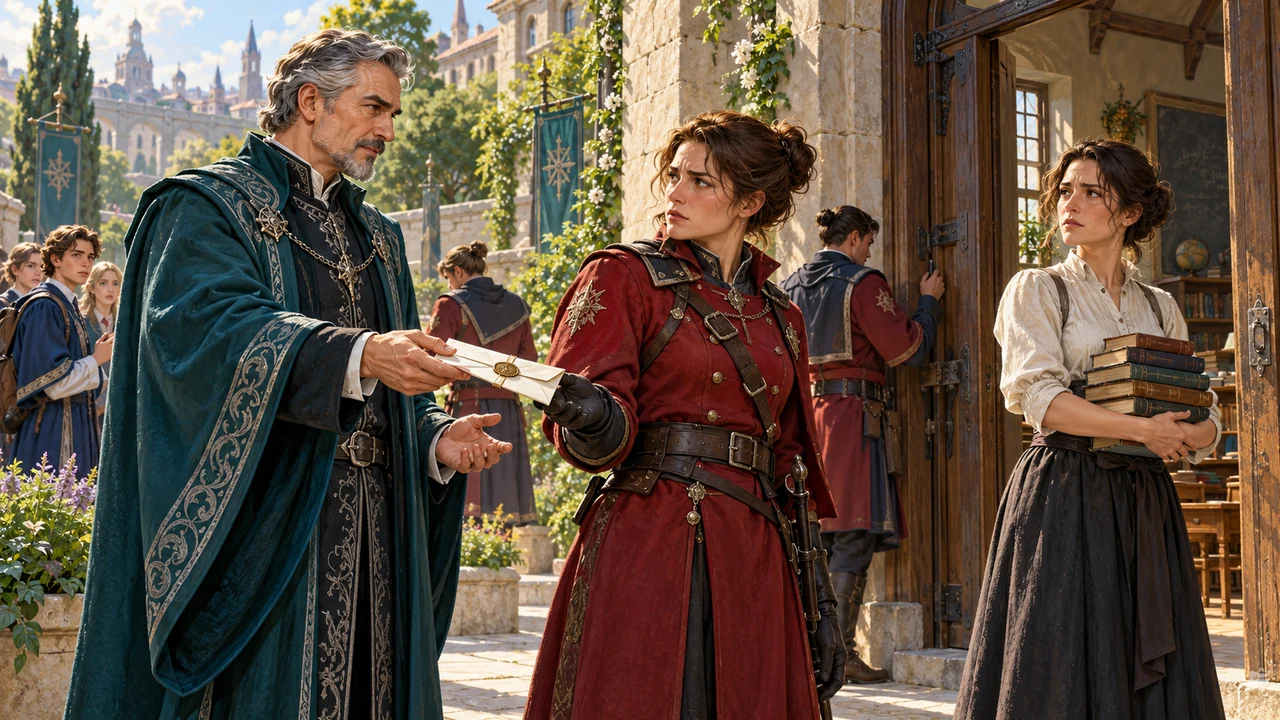
Victor, director of the Royal Academy, stands outside the school and watches a teacher carry textbooks out of the classroom.
He hasn’t ordered the books burned.
He has even promised that teachers may return to their classrooms once the Academy approves them again.
But applying costs money. The Academy decides how long the review takes. And this school’s students are here because they cannot afford the Academy’s fees in the first place.
Someone has to take responsibility for magical education, Victor says.
Sara, the enforcement captain beside him, once agreed with that statement. She supports suspending unsafe classes. She doesn’t yet know that his next step is to arrest teachers who refuse to stop teaching.
If we describe Victor only as “power-hungry,” he remains vague.
Once we know what he wants, how he intends to get it, whose cooperation he needs, and whom he is willing to make pay, he becomes more than a name waiting for the protagonist to defeat.
To write a compelling villain, start with a goal that isn’t merely a reaction to the protagonist. Give them resources, limits, actions, and choices when things go wrong. Their presence comes not just from how evil they are, but from what they are doing to other people’s lives.
This guide uses Victor’s campaign to control magical education to explore villain design, scene writing, a character worksheet, and revision checks. At the end, we’ll see how InkWeave preserves the changes those actions make to organizations, relationships, and locations throughout the story.
Contents
- Give the villain a goal beyond opposing the protagonist
- Separate their reasons, benefits, and chosen harm
- Establish resources, dependencies, and limits on knowledge
- Reveal the villain through action, not just explanation
- Make the villain choose again after a setback
- A villain worksheet and revision checklist
- Writing villains FAQ
- Keep a villain’s plans and consequences connected with InkWeave
Give the villain a goal beyond opposing the protagonist
Start with one question:
If the protagonist didn’t interfere, what would this person do next month?
If the only answer is “kill the protagonist” or “stop the protagonist from succeeding,” go back a step. What, exactly, is the protagonist getting in the way of?
In some revenge stories, the villain’s goal really does center on the protagonist. That’s fine. But the writer still needs to know what outcome the villain seeks through revenge, rather than having them wait for the protagonist to appear in the next scene.
Victor wants the kingdom to give the Royal Academy sole authority to license magical education before the autumn council session.
South Lane School, where the protagonist studies, is one of the independent schools opposing the arrangement. Even if the protagonist dropped out, Victor would still seek authorization, bring teachers under his control, persuade council members, and deal with other opponents.
That gives the story two people taking action, rather than a protagonist and a device for putting obstacles in their path.
| Abstract description | What can you ask next? | Victor’s specific answer |
|---|---|---|
| He wants power. | What does he want to control? | Whether schools of magic may teach, and whether their teachers can obtain qualifications. |
| He wants to restore order. | What situation does he want to end? | The continued growth of magical education outside the Academy’s supervision. |
| He wants to win. | What result would count as success? | The council formally grants the Academy exclusive licensing authority at its autumn session. |
| He is proactive. | What is he doing right now? | Building support, securing authority for temporary closures, and sending officers to schools. |
| He opposes the protagonist. | What condition does the protagonist change? | The protagonist finds the full inspection report, prompting the enforcement captain to question the operation. |
A specific goal doesn’t mean your character has to explain the plan like a business report.
Readers don’t have to know the deadline or arrangements immediately. Understanding them yourself helps actions in different scenes point toward the same result.
His refusal to delay a review, his eagerness to show council members progress, and his insistence on closing schools before the session are no longer random displays of severity.
They come from an outcome he is trying to reach.
Separate their reasons, benefits, and chosen harm
Giving a villain reasons isn’t the same as defending them.
The problem Victor identifies can be real: an accident involving magic occurred at a school with inadequate training.
But “safety needs to improve” doesn’t establish that “only the Royal Academy should decide who may teach.” Still less does it establish that “everyone opposing reform should be arrested.”
A character can sincerely believe their reasoning and benefit personally from the measures they propose. These don’t have to be mutually exclusive.
| What needs separating? | Victor’s example | What should the writing make clear? |
|---|---|---|
| The problem he identifies | Some schools lack safety training, and accidents have occurred. | The problem can be real. You don’t have to make it entirely fabricated to show that he is wrong. |
| His explanation of the problem | Safety cannot be guaranteed while teaching remains decentralized. | This is his judgment, not a universal truth the writer must endorse. |
| What he gains | The Academy controls qualifications, admissions, and teaching resources, strengthening his own position. | Don’t hide personal power and benefits behind idealistic language. |
| Whom he is willing to sacrifice | Teachers and students who caused no accident but cannot afford to reapply. | Make the harm part of specific lives, rather than simply saying “many people suffer.” |
| The line he chooses to cross | He knows South Lane School passed inspection but still intends to arrest teachers for refusing to comply. | Hold the villain responsible for choices, rather than explaining everything through backstory. |
A more revealing question is:
If someone proposes a way to improve safety that gives him less control, will he accept it?
Teachers could propose shared safety standards, public accident records, and a review process involving different schools.
Victor can consider that seriously or reject it. What reveals him is his response, and how far he is willing to go to preserve his original approach.
An eloquent speech doesn’t automatically give a villain depth.
Nor does losing someone in the past put everything they do afterward beyond question.
Writing note: Understanding isn’t absolution, and cruelty isn’t depth
A villain doesn’t need a tragic childhood or a belief that they are saving the world. Vanity, greed, revenge, and the defense of privilege can all sustain a strong character. Making someone understandable doesn’t require excusing them. Adding cruelty doesn’t automatically make them more complex, either. What matters is whether their reasons, methods, and consequences reveal recognizable choices.
Establish resources, dependencies, and limits on knowledge
Once the villain has a goal, ask what puts it within reach.
Resources aren’t limited to armies and money.
The influence of an office, a subordinate’s expertise, victims’ inability to oppose them openly, and public fear of a particular danger can all help advance a plan.
But those resources need limits.
Being the Academy’s director doesn’t let Victor command every council member, control every guard, or make every teacher abandon their own judgment.
| Who or what does he depend on? | Why do they cooperate? | Where does that cooperation end? |
|---|---|---|
| The Royal Academy’s faculty and facilities | Some teachers believe standardized training improves safety and hope for more resources. | They may not support treating dissent as a crime. |
| Sara, the enforcement captain | She has dealt with accidents involving magic and will enforce authorized suspensions for safety checks. | She hasn’t agreed to arrest teachers who passed inspection and harmed no one. |
| Finn, the deputy captain | He wants a chance to lead and is eager to seem more decisive than Sara. | He needs actual personnel and authority, and he can make mistakes. He isn’t an unlimited replacement resource. |
| The council’s temporary support | Council members want to respond to public fear after accidents. | Authority to suspend classes temporarily need not include permanent closures or arbitrary arrests. |
| Accident and inspection reports | The reports appear to give the campaign a factual basis. | Their full contents may not support Victor’s accusations against every school. |
These limits don’t make the villain weak.
They give him work to do: persuade Sara, conceal inconvenient parts of a report, promise Finn a promotion, or produce results before the council loses patience.
Establish his sources of information, too.
How does he know the protagonist obtained the report? Did someone tell him? Did the protagonist show it publicly? Or has he only discovered that someone accessed the records?
Knowing a record was accessed doesn’t tell him which pages were copied. Noticing Sara’s hesitation doesn’t tell him everyone she has spoken to.
A villain can be intelligent, prepared, and mistaken. Don’t give them permanent access to everything the writer knows just to make them seem powerful.
Likewise, outward obedience doesn’t mean subordinates have no goals of their own.
Sara supports safety checks. Finn wants promotion. Teachers want to preserve their resources. People in the same organization may do the same things for a while without sharing the same reasons.
Those differences become especially useful sources of conflict when the plan starts going wrong.
Reveal the villain through action, not just explanation
A villain doesn’t have to appear early.
But their actions should gradually create a sense of continuing pressure.
South Lane School receives a suspension notice. Students must find somewhere else to study. Teachers discuss whether they can object publicly. All this can happen before Victor delivers his first long speech.
Don’t leave all the harm in dialogue.
If someone says, “The director has left a lot of people without classes,” readers receive information. If a teacher is carrying tomorrow’s lesson materials out of the classroom while a student asks where the next lesson will be, readers encounter a situation.
| Scene | What is the villain advancing? | What can readers see? |
|---|---|---|
| A public statement to the council | Use a real accident to win support for his reforms. | He can identify a problem, but chooses which details to leave out. |
| The closure outside the school | Turn authority into restrictions on everyday life. | People uninvolved in the accident still pay for the policy. |
| A private conversation with Sara | Ask her to escalate a suspension into arrests. | How he treats someone who supported him but now asks questions. |
| The plan comes under challenge | Decide whether to concede, negotiate, or appoint someone else. | Whether his core pursuit matches his stated principles. |
One of these moments can be small.
Victor puts the order in front of Sara and says the teachers must be brought to the Academy tomorrow.
Instead of taking it, Sara opens the inspection report to the page on South Lane School.
“Nothing here says they’re unsafe.”
“It describes the day of the inspection,” Victor says.
“Then what charge am I arresting them on?”
Rather than answer, Victor asks whether she has forgotten the people hurt in the last accident.
The narrator doesn’t need to announce that he is manipulative.
Readers have watched him turn a question about a specific order into a challenge to Sara’s moral position.
But don’t have every conversation repeat the same maneuver.
He can be patient, skilled at acknowledging part of the truth, or courteous in public. What matters is that different methods serve the same developing goal, rather than giving him only a stock “villain voice.”
Make the villain choose again after a setback
The protagonist obtains the full report and shows Sara that South Lane School has not been found unsafe.
Sara remains willing to conduct proper inspections. She refuses to lead the teachers’ arrest.
That needn’t make Victor fall apart. Nor should it change nothing.
The officer he relied on no longer accepts this order. Something now has to change.
| Response to the setback | What could Victor do? | What does it reveal, and what does it cost? |
|---|---|---|
| Adjust the goal or method | Accept shared safety standards and give up exclusive licensing authority. | He still values safety, but must acknowledge that control isn’t the only solution and surrender power he wanted. |
| Negotiate and delay | Postpone the arrests and offer resources in exchange for the school accepting limited oversight. | How far he will compromise, while the session approaches and supporters grow impatient. |
| Cross an earlier boundary | Put Finn in charge and place his idea of order above the limits of his authority. | His need to control the outcome, at the risk of internal division, operational mistakes, and lost credibility. |
These aren’t the only three answers a novel can offer.
They help avoid a familiar stall: the protagonist disrupts the plan, the villain says, “Everything is still under control,” and the story proceeds exactly as before.
If your version takes the third path, introduce Finn earlier.
He has already asked to lead and criticized Sara’s caution. Giving him command now grows from an established character, rather than conjuring a more obedient force from outside the story.
Keep the practical costs, too.
Finn knows fewer of the city’s districts and needs time to reassign personnel. Sara loses command but doesn’t stop knowing what happened. Other members who see her removed may reconsider what they support.
The protagonist hasn’t immediately overthrown the director. Their actions have still changed the situation he must face next.
And Victor’s decision to keep applying pressure shows readers which he protects first when his stated concern for safety conflicts with personal control.
Revision note: Don’t let a backup plan erase the protagonist’s impact
Backup plans need people, time, resources, and prior arrangements. Replacing Sara with Finn should change the operation and its risks, not merely change a name. The villain doesn’t have to lose immediately, but the protagonist’s intervention should leave a difference in what follows.
A villain worksheet and revision checklist
You don’t need to finish the villain’s childhood, family tree, and every hobby first.
Use this worksheet to see whether the character can sustain an unfolding conflict. Leave anything you don’t need blank for now.
| Design question | Victor’s example | Your villain |
|---|---|---|
| What do they want to accomplish, apart from the protagonist? | Secure exclusive licensing authority over magical education at the autumn council session. | ______ |
| What would count as success? | The council approves the system, making other schools subject to the Academy’s review. | ______ |
| Why do they believe it is worth doing? | He believes decentralized teaching cannot ensure safety. | ______ |
| What do they personally gain? | Resources, control over qualifications, and a stronger position as director. | ______ |
| Who pays for their choices? | Teachers and students who cannot afford the fees, and schools that refuse to comply. | ______ |
| What can they call on now? | Academy resources, limited authorization, and officers led by Sara. | ______ |
| Whom do they depend on, and where are that person’s limits? | Sara supports safety checks but refuses arrests without grounds. | ______ |
| What do they know, and how? | Someone accessed the full report, but he doesn’t yet know who has received it. | ______ |
| What will they do next? | Stop the teachers from teaching, then bring those who refuse to comply to the Academy. | ______ |
| How do they respond when a key prerequisite is lost? | Remove Sara from command, put Finn in charge, and accept greater risks. | ______ |
| What lasting consequences does this action leave? | Students lose classrooms, divisions emerge within the organization, and later operations lose their original support. | ______ |
Then choose an important scene involving the villain and check six things:
- Are they pursuing a specific result, rather than appearing only to threaten the protagonist?
- Do their actions use authority, resources, and information already established in the story?
- Whom do they harm, and how does that person’s life change afterward?
- Why do other people cooperate, and do those people still exercise their own judgment?
- Does the protagonist’s intervention actually change a condition, cost, or method?
- If this scene were removed, what later events should no longer happen in the same way?
If your villain only ever sends people to attack, try another kind of action.
They might withdraw a qualification, change the terms of cooperation, demand a public declaration, or force two people who once supported each other into different choices.
A threat doesn’t have to grow larger every time to create pressure.
When characters start losing work, relationships, or ways of life they once relied on, the villain is already part of the story.
Writing villains FAQ
Does a villain need a sympathetic backstory?
No.
Readers can form a clear picture of someone by understanding what they want and why they choose a particular method. Backstory can deepen that understanding, but it isn’t a bargaining chip that cancels consequences.
You can write someone who enjoys privilege and refuses to give it up without adding that they are secretly trying to save someone.
Does the villain have to be stronger than the protagonist?
Not necessarily.
They may have an advantage in only one area: control over qualifications, knowledge of the rules, public trust, or an earlier start.
Pressure can also come from the protagonist’s unwillingness to use the same methods, rather than a lack of strength. What matters is that the conflict reaches something the protagonist cares about and cannot easily abandon.
Are villains and antagonists the same thing?
Not quite.
An antagonist may simply have a goal that conflicts with the protagonist’s, without doing anything morally reprehensible. A rival pursuing the same opportunity or a family member refusing to cooperate can both create opposition.
Victor is treated as a villain here not merely because the protagonist opposes him, but because he knowingly deprives innocent people of choices and keeps applying pressure to preserve control. Don’t equate “doesn’t support the protagonist” with evil.
Can a villain have a strong presence before appearing?
Yes.
Let their decisions enter scenes through orders, institutions, subordinates, and the people affected. Readers can see the classroom close before meeting the person who chose to close it.
But not everything bad needs to come from one person. Let others retain their own actions and responsibilities. The world will feel more credible than one where the villain arranged every problem.
Must the villain change or be punished at the end?
No.
They can refuse to change, win, compromise, or lose only part of what they wanted. An ending doesn’t have to settle everyone’s moral score.
But important earlier choices should leave recognizable effects. Even if Victor keeps his position, Sara’s willingness to carry out his orders and the teachers’ belief in his promises may no longer be the same.
Keep a villain’s plans and consequences connected with InkWeave
By this point, you can design a villain who takes action and faces limits.
InkWeave addresses what happens once those actions are part of the story: how to keep later scenes consistent with the changes they have caused.
You don’t have to build a database for the entire kingdom first.
Start with Victor, Sara, Finn, the Royal Academy, and South Lane School. That’s enough to place this conflict in a world whose state changes through events.
Keep organizational roles separate from personal support
The Royal Academy can be a faction, with members, titles, and a reporting structure.
Victor is the director. Sara is the enforcement captain. Finn is her deputy. As you record the relevant personnel changes, the organization chart shows the arrangements at your cursor’s position in the story.
Personal relationships can be recorded separately.
Sara’s earlier trust in Victor doesn’t mean she agrees with every order. Refusing to arrest teachers doesn’t mean she has formally left the Academy. If you choose to record a change in trust, the relationship map and organization chart can show different aspects of the same situation.
| What has been confirmed in the story? | What event could you record? | What needn’t follow automatically? |
|---|---|---|
| Sara questions the director, and you confirm that her trust has changed. | A corresponding relationship change. | She leaves the organization, or all her colleagues change their positions too. |
| Victor changes the command arrangements. | Changes to Sara’s and Finn’s organizational titles and relevant reporting relationships. | Receiving Sara’s title gives Finn all her experience and personal support. |
| A member actually leaves later. | An organizational departure at that point, with any necessary arrangements for subordinates. | Refusing one order makes everyone connected to that person leave as well. |
Move the cursor back to before the closure, and you can see Sara’s original position. Only after the replacement do you see the new command structure.
If you need to ask when she stopped leading the officers, the history can take you back to the change, rather than leaving you with a chart that always shows only the latest appointments.
Let an order change the actual scene
A school receiving a notice and a school becoming inaccessible are different events.
In this version, teachers and students leave first. When you confirm that the entrance has been closed and entry prohibited, record that location-state change at the relevant point.
The appropriate state here is “No Entry”: people can leave, but cannot enter as before. It doesn’t mean the classroom is destroyed or that everyone is trapped inside.
| Where is the cursor in the story? | What state can you bring into view? | How does it help you write? |
|---|---|---|
| Before the closure | Characters recorded as present at the school, and its original location state. | Return to ordinary school life without seeing later consequences too early. |
| After teachers and students leave | New positions resulting from movement events; entry may not yet be prohibited. | Keep departure separate from a change to entry restrictions. |
| After the No Entry event | The school’s current restriction and any recorded items still there. | See that the classroom and desks remain, but can no longer be used as before. |
| When a character later tries to enter | Check the movement event against the location’s state at that point. | Avoid carrying an earlier classroom routine into later scenes unchanged. |
As you write about established characters and locations, the scene-aware view and Inspector beside your manuscript bring back their information at the cursor. Images you’ve added for them can appear too.
When the protagonist and school form a supported interaction, the event wizard can show the current location and ask you to confirm whether a movement actually happens. Two names in one sentence don’t automatically send someone into the classroom.
If you later record the protagonist entering the school while No Entry still applies, the Causality Engine flags the mismatch and provides the source event that established the restriction.
You can return to the closure and decide whether this scene occurs after reopening, involves an exception that needs explaining, or needs revision. The warning doesn’t delete the scene or choose a solution for you.
If the story needs different access permissions for different identities, you can model explicit conditions separately. A location-wide No Entry state isn’t a rule that automatically recognizes uniforms and passes.
Leave the plan’s prerequisites in a future scene
Victor originally intends Sara to lead the teachers’ arrest.
You can keep that planned operation without assuming the earlier cooperation is already settled simply because the scene comes later.
For this version, you choose two prerequisites to track and place flag events where the corresponding results are actually confirmed.
| What do you want to track? | How could you record it? | What doesn’t it imply? |
|---|---|---|
| Whether this arrest operation has valid authorization | A Boolean flag: “Authorization for this arrest operation remains valid.” | Permission to suspend classes automatically grants permission to arrest teachers. |
| Whether Sara has explicitly agreed to lead this operation | A Boolean flag: “Sara has confirmed she will lead the arrests.” | Still being captain means she accepts every order. |
| The plan’s current stage | If useful, an enum flag with stages such as seeking support, suspending classes for inspection, preparing arrests, and changing the plan. | The engine infers the completed stage from character dialogue. |
In the planned passage where Sara leads the arrests, insert a condition-check anchor, or REQ, requiring the first two flags to be true.
Even before you’ve finished writing the authorization and negotiations, the later operation holds a clear set of prerequisites to address. Your cursor can stay in the scene outside the school while the project-wide dashboard shows what the future scene still lacks.
You are tracking explicitly defined facts, not asking the engine to interpret the kingdom’s law.
If you later decide Victor will act without authorization, you can change the requirements and let the story deal with the consequences of overstepping. A villain breaking the law doesn’t mean you cannot write it. What needs updating is the earlier version in which the operation was authorized and Sara agreed to carry it out.
Likewise, replacing Sara with Finn doesn’t make “Sara has confirmed she will lead the arrests” true.
Change the operation to Finn’s command, record the new assignments and confirmations, and check the prerequisites for that version. A plan that has lost someone’s cooperation cannot borrow the old answer by changing a name.
Recheck later scenes when one step changes
Suppose Sara agreed to lead in the original draft. During revision, you decide she refuses after reading the report.
When you revise the scene and update the corresponding flag to show she hasn’t agreed, the later operation can no longer rely on the original commitment.
| Which recorded result changes? | What remains later? | What can the Causality Engine flag? |
|---|---|---|
| Sara now refuses, and you update the flag recording her agreement. | The scene where Sara leads the arrests still requires her confirmation. | Her cooperation at this point doesn’t meet the requirement. |
| You remove the event establishing arrest authorization, with no other valid source. | The later operation still requires authorization. | A required condition hasn’t been established. |
| You move authorization after the operation, with no earlier source. | Authorization is still required when the operation happens. | A later result cannot satisfy an earlier requirement. |
| You move the school’s No Entry event earlier but keep a subsequent movement into the school unchanged. | The character still acts as though the original location state applies. | The movement conflicts with the restriction, and you can trace the event that imposed it. |
After saving, InkWeave automatically validates the whole project. The affected events and project-wide dashboard show the issues. Go to the relevant passage, follow the history back to its source, and choose whether to establish an earlier cause, change the plan, or revise a later scene.
Save again after revising, and the conditions are checked again. You don’t need to maintain a separate up-to-date account for every chapter. Nor will the engine quietly supply authorization or a willing captain just to make the later scene pass.
Feature note: Validate explicit records, not guesses about a character’s mind
Rewriting dialogue alone doesn’t make the engine conclude that Sara has changed her position. When a result you want to track changes, update the corresponding relationship, organization, location, or flag event. Later states are then calculated from the new records. The engine doesn’t arrange for subordinates to complete a plan merely because the director mentions it.
These world-state calculations and condition checks come from InkWeave’s in-house Causality Engine. It uses explicit events and rules for deterministic calculation, not AI reviewing the manuscript, guessing a villain’s intentions, or generating their plan.
It preserves what you’ve already had characters do, so you can move on to their next choices with confidence.
Return to an earlier passage, and Sara still stands beside the director. Move past her refusal, and her organizational position may be unchanged while her recorded trust and cooperation are different. Farther on, Finn holds the new command, and South Lane School is still empty.
Writing becomes an adventure you can follow through the world you’ve created. Characters have faces, places change, and the combined consequences of a few choices become visible beside your manuscript.
You don’t have to stop and fill in a form after every sentence.
Getting started: Record one or two changes that matter later
You can begin with just the director, the captain, and the school, recording a closure or an important change in cooperation. Other teachers, every meeting, and passing emotions can wait until needed or remain in the prose alone. A few events you choose to record already provide past states, historical sources, and later validation. You don’t have to set up the entire Academy first.
To create characters and record a scene change, start with the Getting Started guide. For downloads and available plans, see InkWeave Pricing.
Back outside the school, Sara watches the teacher carry out the last few textbooks.
She hasn’t left the Academy. She still wants to prevent the next accident involving magic.
But she finally asks: why must people who passed inspection lose their classroom too?
Victor’s answer will change their relationship, and the lives other people in this city can lead.
A villain’s power doesn’t necessarily depend on having the strongest abilities, the saddest past, or the best speech.
It can lie in making other people face choices they would never otherwise have needed to make.
They have a goal of their own.
And the world remembers who paid the price for it.